Understanding the Role of Orbiting Satellites in Modern Technology
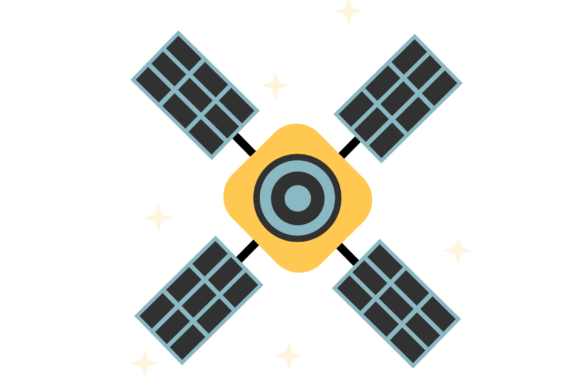
In today's fast-paced world, technology has become an integral part of our daily lives. One of the most fascinating and essential components of modern technology is the orbiting satellite. These advanced machines, often depicted as a yellow square with a dish-like circle and four rectangular solar panels, play a crucial role in communication, research, and exploration. Whether you're using your smartphone to send a message or watching a live broadcast from across the globe, satellites are likely involved in making it happen.
What Is an Orbiting Satellite?
An orbiting satellite is a man-made object designed to travel around the Earth or other celestial bodies. These satellites are equipped with various technologies that allow them to perform specific functions. The illustration of a satellite with a central yellow square, a dish-like circle, and four solar panels is a common representation of such devices. This design is not only visually appealing but also functional, showcasing the satellite's ability to communicate and gather data from space.
The central body of the satellite, often a yellow square, serves as the main housing for its internal systems. The dish-like circle is typically a communication antenna, responsible for transmitting and receiving signals. The four rectangular solar panels, positioned on all sides, provide the necessary power to keep the satellite operational while in orbit.
The Purpose and Significance of Satellites
Satellites have a wide range of purposes, from telecommunications to weather forecasting and global positioning systems (GPS). They are used by governments, businesses, and individuals to access information, communicate, and navigate the world. For example, GPS satellites help users find their way by providing precise location data, which is essential for everything from driving directions to delivery services.
Additionally, satellites are vital for scientific research. They can monitor the Earth's climate, track natural disasters, and even explore other planets. The data collected by these satellites helps scientists understand our planet and the universe better, leading to advancements in various fields such as environmental science, astronomy, and meteorology.
How Satellites Fit Into Modern Life
The impact of satellites on modern life is profound. In the realm of telecom companies, satellites are used to provide internet and television services to remote areas where traditional infrastructure is lacking. This allows people in rural regions to stay connected and access essential services, bridging the digital divide.
In education, satellites are used to deliver distance learning programs, enabling students to access quality education regardless of their location. Educational tools that incorporate satellite imagery and data help students learn about geography, environmental science, and space exploration in an engaging and interactive way.
For space game assets, satellites serve as a source of inspiration and design elements. Game developers often use satellite illustrations to create realistic space environments, enhancing the gaming experience and educating players about space technology.
Practical Relevance of Satellite Technology
Modern technology relies heavily on satellite systems. From smartphones to aircraft navigation, satellites are at the heart of many technological advancements. For instance, when you use a GPS device to navigate, it communicates with satellites to determine your exact location. This technology is also used in aviation, where pilots rely on satellite-based navigation to fly safely and efficiently.
In the business sector, satellites are used for market research and logistics management. Companies use satellite data to analyze consumer behavior, track supply chains, and optimize operations. This information helps businesses make informed decisions and improve their services.
Moreover, satellites play a critical role in disaster response and emergency management. During natural disasters such as hurricanes or earthquakes, satellite imagery provides valuable information about the affected areas, helping rescue teams plan their operations more effectively.
Common Misconceptions About Satellites
Despite their widespread use, there are several common misconceptions about satellites. One of the most prevalent is the belief that satellites are only used for communication. While this is true, satellites have many other applications, including scientific research, environmental monitoring, and national security.
Another misconception is that satellites are always visible in the night sky. In reality, most satellites are too small and far away to be seen with the naked eye. However, some large satellites, such as the International Space Station, can be observed under certain conditions.
It's also important to note that not all satellites are launched into space by governments. Private companies and organizations also launch satellites for various purposes, contributing to the growing field of commercial space exploration.
Future of Satellite Technology
The future of satellite technology looks promising, with ongoing advancements in miniaturization, connectivity, and data processing. Smaller, more efficient satellites are being developed, making space exploration more accessible and cost-effective. These innovations are expected to revolutionize industries such as telecommunications, agriculture, and urban planning.
Additionally, the rise of low-Earth orbit (LEO) satellite constellations is set to transform global internet access. Companies like SpaceX and Amazon are working on deploying thousands of satellites to provide high-speed internet to underserved regions, further connecting the world.
As technology continues to evolve, the role of satellites will only become more significant. Their ability to collect and transmit data from space will continue to drive innovation and improve our understanding of the universe.
Conclusion
Orbiting satellites are a cornerstone of modern technology, playing a vital role in communication, research, and exploration. The illustration of a satellite with a yellow square, a dish-like circle, and four solar panels captures the essence of these advanced machines, highlighting their functionality and reliability. Whether used in telecom companies, educational tools, or space games, satellites continue to shape our world in ways we may not always notice.
By understanding the purpose and significance of satellites, we can appreciate the technological marvels that enable us to connect, learn, and explore the vastness of space. As we look to the future, the continued development of satellite technology promises to bring even more opportunities and advancements, making our world more interconnected and informed.